
What’s the Financial Difference Between Renting and Leasing a Copier?
Leasing a copier costs less per month but locks you in for three to five years, while renting costs 30 to 60 percent more per month but lets you walk away with no long-term commitment. The right choice depends on whether your office needs the machine for years or months.
TL;DR
Copier leasing typically runs $150 to $800 per month on a 36 to 60 month term and delivers a lower total cost of ownership for offices with stable, long-term print needs, while copier rental costs more monthly but carries zero balance sheet liability and suits temporary projects under a year. Lease payments are generally deductible as an operating expense, while $1-buyout capital leases may qualify for Section 179 treatment. Auto-renewal clauses and early termination penalties are the two biggest hidden costs in lease contracts, with missed notice windows of 30 to 90 days potentially locking a business into another year of payments.
Key takeaways
- Typical lease payments range from $200 to $800 monthly over 36 to 60 months, while equivalent rentals run 30 to 60 percent higher per month but create no long-term balance sheet liability.
- A worked example shows a mid-range color MFP leasing at $250 per month for 48 months totals $12,000 in base payments, versus $1,350 to $1,650 for the same machine rented over a 3-month project.
- Lease payments are generally deductible as an operating expense, while $1-buyout capital leases may qualify as a capital expense with Section 179 benefits, subject to current tax rules and your CPA’s guidance.
- Auto-renewal clauses typically extend a lease another 12 months if written notice isn’t sent within a 30 to 90 day window, so calendar reminders six to nine months before term end are essential.
- Breaking a lease early usually requires paying the full remaining balance minus a small discount, plus pickup and data-wiping fees of $200 to $500, while rental agreements allow much easier exit with minimal penalties.
Your office needs a copier, and the sales rep is pushing a five-year lease. Before you sign, it helps to know the real financial difference between renting and leasing a copier. In short: leasing costs less per month but commits you for years, while renting costs more per month but lets you walk away. The right choice depends on how long you need the machine and how your business handles expenses.
At Clear Choice Technical Services, we service and repair copiers under every kind of agreement through our copier repair, sales, and leasing solutions. We regularly see business owners surprised by early termination fees and auto-renewals they never noticed. This guide breaks down the costs, the tax treatment, and the contract traps so you can decide with confidence.
Why the Lease vs. Rental Decision Matters Financially
Picture two businesses. A 10-person accounting firm in Denver needs a color multifunction printer for the next four years. Down the street, a construction crew needs the same machine for a six-month jobsite. Both need print, but the financial difference between renting and leasing a copier will save – or cost – each one thousands of dollars.
Leasing a copier usually results in lower monthly payments and predictable costs over a multi-year horizon. Renting limits long term commitment but is more expensive per month. Many businesses pick whichever a vendor suggests without running the numbers. That is expensive.
At Clear Choice Technical Services, we offer both copier leasing and short-term copier rental. We are not here to push one over the other – we are here to help you make an informed decision based on real math. Below, we break down TCO, OPEX vs CAPEX treatment, early-exit costs, and auto renewal traps so you can choose what fits your business needs.
The Financial Snapshot: How Does Leasing a Copier Differ from Renting One?
A copier lease is a multi-year contract (typically 36–60 months) with lower monthly costs and a service agreement bundling maintenance and toner, often structured through business copier rental and leasing options. A copier rental is a short-term arrangement (1–24 months) with higher monthly payments but no long-term copier lease liability. Equipment ownership remains with the leasing company until purchased.
| Feature | Copier Lease | Copier Rental |
| Term length | 36–60 months | 1 day to 24 months |
| Monthly cost | 150–350 mid-range; 350–800+ production | 350–700 mid-range; desktop 99–175 |
| Cost per copy (B&W / color) | ~$0.01 / 0.06–0.09 | Similar overage rates, less base included |
| Balance sheet | Operating or finance lease liability | Off balance sheet (pure OPEX) |
| Maintenance included | Bundled via service agreement or CPP | Usually all-inclusive |
| Early exit risk | Penalties up to full remaining payments | Minimal; pickup/damage fees possible |
| Best for | Stable offices, 3+ year horizon | Temporary offices, temporary projects, seasonal surges |
For example, leasing a mid-range color MFP at $250 per month for 48 months costs $12,000 in base payments. Renting a similar device for a 3-month project at 450–550 per month totals 1,350–1,650 – a higher cost per month but a fraction of the total cost. Copier vendors may use the terms renting and leasing interchangeably in contracts, so always confirm the lease term and exit terms before signing.
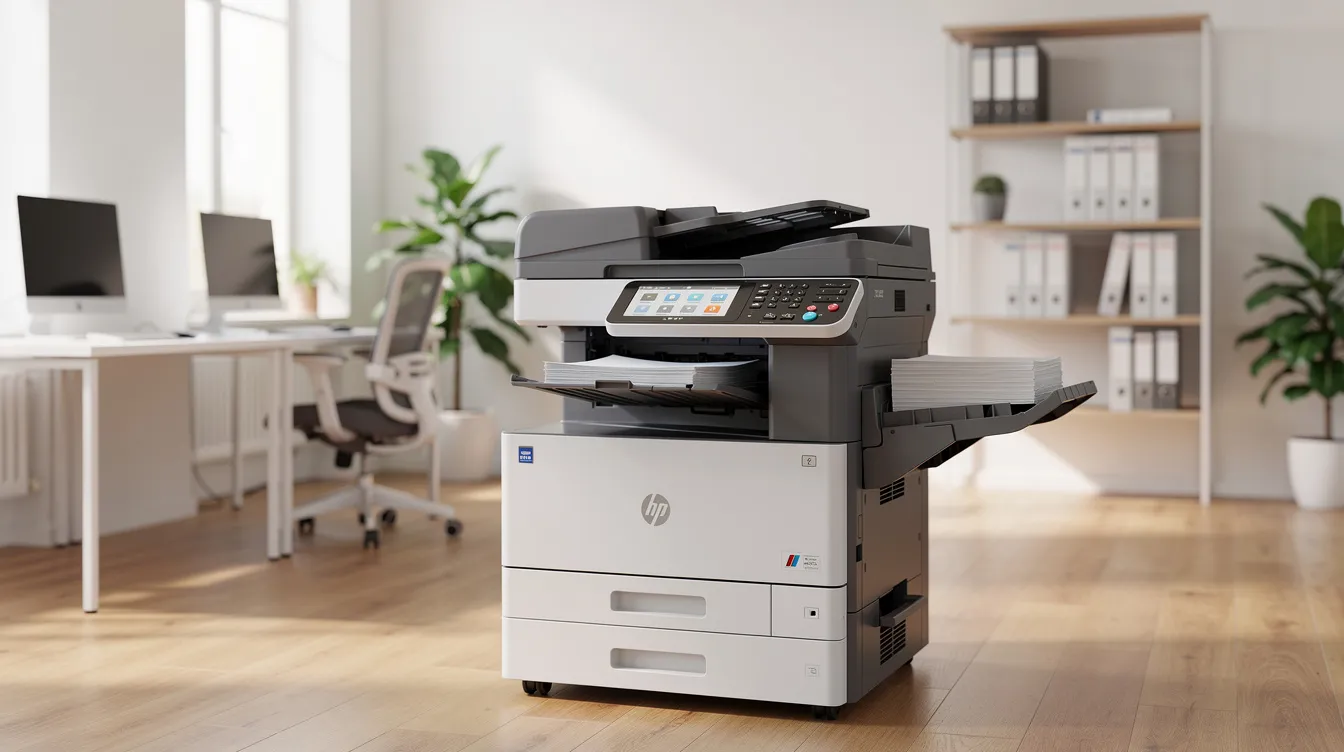
Total Cost of Ownership (TCO): What Do the Real Numbers Look Like?
TCO is the entire cost of using a copier over your usage period: base payments, click charges, supplies, overages, delivery, and end-of-term fees. A copier lease generally yields a lower TCO for stable, three to five years needs. Rentals make sense financially for sub-12-month projects, especially when supported by detailed service and parts manual documentation that helps keep devices running efficiently.
How Much Does It Cost to Lease a Commercial Copier Each Month?
The average monthly payment to lease a commercial copier runs $200 to $800 depending on speed, color capability, and print volume. Leasing costs are amortized over several years, resulting in lower monthly rates than renting. Companies in high-volume document industries often benefit more from leasing due to lower cost per page.
Here is a concrete example: a business printing 5,000 pages per month (70% B&W, 30% color) on a 48-month lease at $250 per month. Base payments total $12,000. Color overages at $0.07 per page add roughly $3,360. End-of-lease return costs (freight, hard drive wipe, accessories) add about $1,000. That puts TCO near $16,360, or about $341 per month effective cost. You can calculate your own cost per page to see where your volume falls.
Total payments for a 60-month lease can reach $22,200 or more. Leasing often costs more over time due to financing costs, and buying a copier can save 25–40% compared to leasing. Reading detailed multifunction printer reviews and warnings can also help you understand long-term reliability risks before committing. But leasing typically requires little to no upfront investment, which is why 82% of businesses choose to lease their copiers.
What Is the True Cost of a Short-Term Copier Rental?
Short-term copier rental for a standard color MFP runs 350–700 per month, plus delivery and pickup fees of 250–400. Rental agreements usually include maintenance and service in the monthly cost, which simplifies budgeting.
For a 3-month construction trailer project at the same 5,000 pages per month, expect about $1,405 total – roughly $468 per month. That is higher monthly payments than a lease equivalent, but you walk away at month three with no remaining obligation. Rental contracts allow for easy cancellations and changes, promoting flexibility. However, renting generally has higher monthly costs compared to leasing, and renting beyond 12–18 months often surpasses the 36-month lease TCO. Rental agreements are ideal for temporary projects or events like trade shows, and are widely available across multiple U.S. locations served by Clear Choice.
Accounting & Tax Treatment: Copier Lease OPEX vs CAPEX, and Rentals
Both copier leases and copier rentals are usually treated as an operating expense, but certain lease structures (like $1-buyout capital leases) may be treated as capital expenses and can qualify for Section 179. Short-term copier rental is almost always pure OPEX. For organizations that service their own equipment, access to Savin and related copier service manuals can further influence the true cost of ownership.
How Do Copier Leases Show Up on Your Balance Sheet?
A fair market value lease is typically OPEX – FMV lease payments can be fully deducted as operating expenses, and operating leases do not appear as debt on balance sheets. A $1-buyout lease behaves more like a financed purchase: it creates a right-of-use asset and lease liability under ASC 842, allows depreciation schedules, and a qualifying purchase may allow deduction of the full purchase price under Section 179, subject to annual limits and changing tax rules. That matters for your EBITDA and debt ratios – banks look at long-term copier lease liabilities when evaluating credit.
100% of lease payments can be deducted immediately as business expenses on an operating lease, and leasing avoids the complexities of depreciation schedules. Tax deductions are also available for purchased copiers under Section 179, and buying a copier builds balance sheet assets for your business. Ownership eliminates interest payments over the copier’s life, giving you complete control over the equipment. Always confirm treatment with your CPA, since deducting the full purchase price depends on current rules and professional tax advice. Clear Choice Technical Services can structure leasing agreement terms in coordination with your accounting strategy, and our laser printer service documentation and maintenance guides support long-term equipment care.
Are Copier Rentals Always an Operating Expense?
Yes. Copier rental is almost always month-to-month or short term, fully deductible as OPEX, and leaves no long-term liability. It keeps the multifunction printer off the balance sheet entirely. For growing businesses with tightening cash flow or uncertain growth plans, that simplicity has real value.
Contract Risks: Early Termination, Auto Renewal, and Hidden Costs
The biggest financial surprises in lease contracts are not the monthly payment. They are overage charges, auto renewal clauses, and early-termination penalties. Renting usually has fewer long-tail risks but can still include delivery, pickup, and damage fees. Boston commercial real estate is expensive and affects office equipment decisions – and so does local competition, which may influence pricing and service terms for leases and rentals in any market, especially for advanced Canon imageRUNNER Advance multifunction systems and similar enterprise devices.
Can You Get Out of a Copier Lease Early Without Paying Penalties?
Usually no. Breaking a lease early may incur financial penalties – often the full remaining lease payments minus a small discount, plus pickup fees and hard drive wiping (200–500). However, you can negotiate a buyout, roll remaining payments into a new copier machine lease, or work with a provider like Clear Choice Technical Services to absorb part of the balance during an upgrade. The key differences between a graceful exit and a painful one come down to planning and timing.
What Happens When Your Copier Leases Auto-Renews?
Most copier leases include an evergreen clause that automatically extends the lease term for another 12 months if you do not send written notice within a 30–90 day window. That means you could end up paying another year on an aging leased copier that no longer meets your print needs. Set calendar reminders six to nine months before your lease term ends. We help clients track these dates and negotiate exit or upgrade options to avoid auto renewal traps and easily upgrade to the latest technology.
Overage charges also compound: printing 12,000 pages on a 10,000-page allowance can generate 0.01–0.12 per excess page. End-of-term return costs (freight, insurance, certified data wiping for sensitive data) can add 500–1,300. Compare that to rental contract risks – rentals may charge premium rates for extensions, but rarely lock you into multi-year liabilities.
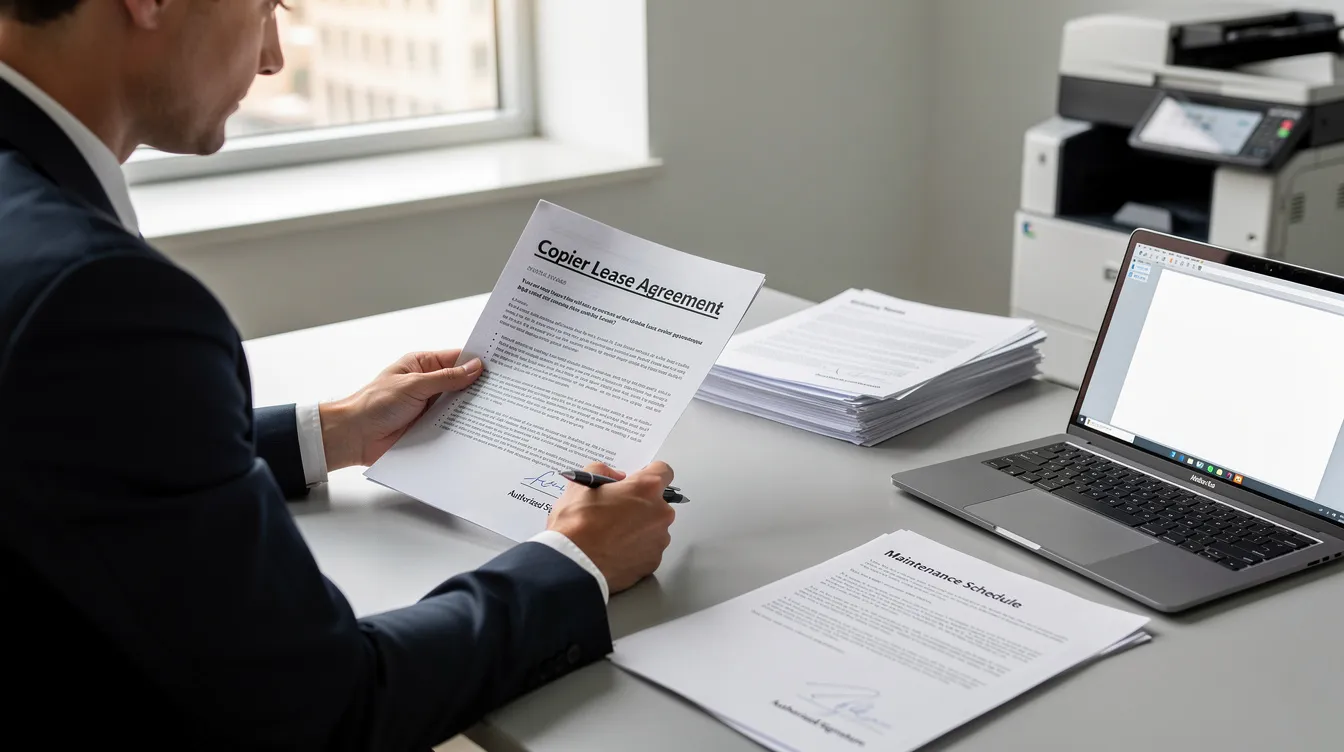
Decision Framework: When Does a Copier Lease Make More Financial Sense Than a Rental?
Copier leasing generally delivers a lower cost per page and better TCO for offices that prefer predictable monthly expenses over a 3+ year horizon. Copier rental is financially smarter for short-term, seasonal, or uncertain needs where flexibility outweighs the higher cost, while some businesses still buy when long term ownership better fits their budget, growth plans, and technology timeline.
A simple decision process: (1) define your expected term – months or years, (2) estimate monthly print volume, (3) review cash flow and credit constraints, (4) assess whether you need to upgrade equipment frequently, and (5) weigh your tolerance for long term commitment.
Consider these scenarios. An accounting firm with seasonal surges leases one multifunction printer year-round and rents a second unit during tax season – a cost effective hybrid. A construction company renting for a 9-month jobsite avoids an outright purchase or lease entirely. A 30-employee professional services firm locks in a 60-month copier lease with managed print services for minimal downtime and predictable monthly payments. Managed print services can streamline document management workflows and reduce overall costs for many businesses, including print shops and firms at multiple locations, while expert copier troubleshooting and repair support minimizes downtime risk on leased or rented devices.
What is the average monthly payment to lease a commercial copier? Typical commercial copier leases in the U.S. run between $150 and $800 per month depending on speed, color, and volume. The purchase price of the same machine might be 5,000–25,000, so leasing turns that upfront investment into a predictable monthly expense. Buying a copier can lower total costs over time for stable volumes, and purchasing can result in lower total costs – ownership benefits include the residual value and the ability to boost productivity without financing costs. But the choice depends on your business model: buying makes more sense when print volume is stable, capital is available, and technology needs change slowly. Many clients use a mixed strategy, allowing businesses to lease core multifunction printers and rent extra devices during peaks.
Conclusion & Next Steps with Clear Choice Technical Services
The financial difference between renting and leasing a copier is a trade between monthly cost and long-term commitment. Lease when you need a reliable machine for three years or more and want the lowest monthly payment. Rent when your needs are short-term or uncertain. Either way, read the fine print on early termination and auto-renewal before you sign.
Get the right copier plan with rapid local support
Whether you need a month-to-month rental or a multi-year lease, Clear Choice Technical Services offers simple copier leasing and rental plans built around your budget. You get clear pricing with no hidden costs, reliable performance, and fast local technical support when you need it.
Not sure whether to rent or lease? Call us now at (617) 221-7774 for a straightforward recommendation.
